


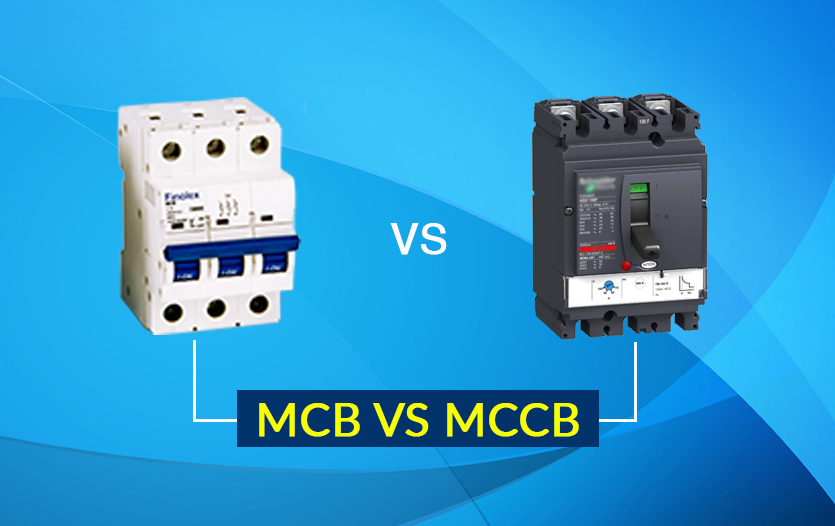
In current electrical systems, circuit breakers are crucial elements. MCBs, miniature circuit breakers, and MCCB moulded case circuit breakers do this by automatically cutting the circuit off in case of a fault, protecting the system against overloads and short circuits. Circuit breakers are available in various types, sizes, and configurations depending on the use and the system’s needs.
This article will address the uses and differences between MCB and MCCB.
MCBs, Miniature Circuit Breakers
Small-sized circuit breakers called mcbs are employed in low-voltage electrical systems.
- Up to a particular current rating, usually between 6 and 63 amperes, they are made to guard circuits against overloads and short circuits. In residential and commercial structures, MCBs are frequently used.
- The principle of heat and magnetic trip governs how MCBs operate. The thermal element heats up and trips the circuit when the current is greater than the rated current of the mcb. The magnetic element in the MCB instantly trips the circuit if the current is too high.
Advantages of MCB:
- One benefit of mcbs is their small size, which makes installation and replacement simple.
- MCBs’ use in high-current systems is constrained because they have a smaller breaking capacity than MCCBs.
MCCBs, Moulded Case Circuit Breaker
MCCB, the moulded case circuit breaker, is a Larger-sized circuit breaker.
- They are used in low-voltage and medium-voltage electrical systems. Up to a particular current rating, usually between 15 and 2500 amperes, they are intended to guard circuits against overloads and short circuits.
- In commercial, industrial, and power distribution applications, MCCB is often employed.
- Similar in function to MCBs, MCCBs offer larger breaking capacity and more sophisticated protection features, such as remote control and programmable trip settings.
- The modular nature of MCCBs makes it simple to configure and customise them for particular applications.
- MCCBs’ can be challenging to install and maintain in remote locations, which is one of their drawbacks. The cost of the electrical system as a whole may be impacted because MCCBs are more expensive than MCBs.
Differences between MCB and MCCB
Circuit breakers of the MCB and MCCB varieties guard electrical systems against overcurrents. Let’s discuss a few of the differences between MCB and MCCB.
- Their application, current rating, and breaking capability are the primary distinctions between MCB and MCCB.
- Current ratings: MCBs, miniature circuit breakers, have a breaking capacity of up to 10 kA and are intended for low-voltage applications.
MCCB, moulded case circuit breaker, handles current ratings and breaks greater capacities, often up to 100 kA.
- Uses: MCBs are utilised in low-voltage applications such as residential and commercial structures.
MCCBs are utilised in high-voltage applications like in commercial and industrial settings to safeguard machinery and heavy-duty equipment.
- MCCBs often offer greater protection and dependability than MCBs while being bigger and more costly.
Final Words
Therefore, consider the electrician’s factors or instructions before installing Circuit Breakers in residential or commercial places. It will help avoid any risk or harm to the building or person. You can browse through Legrand’s website to understand them better.

