


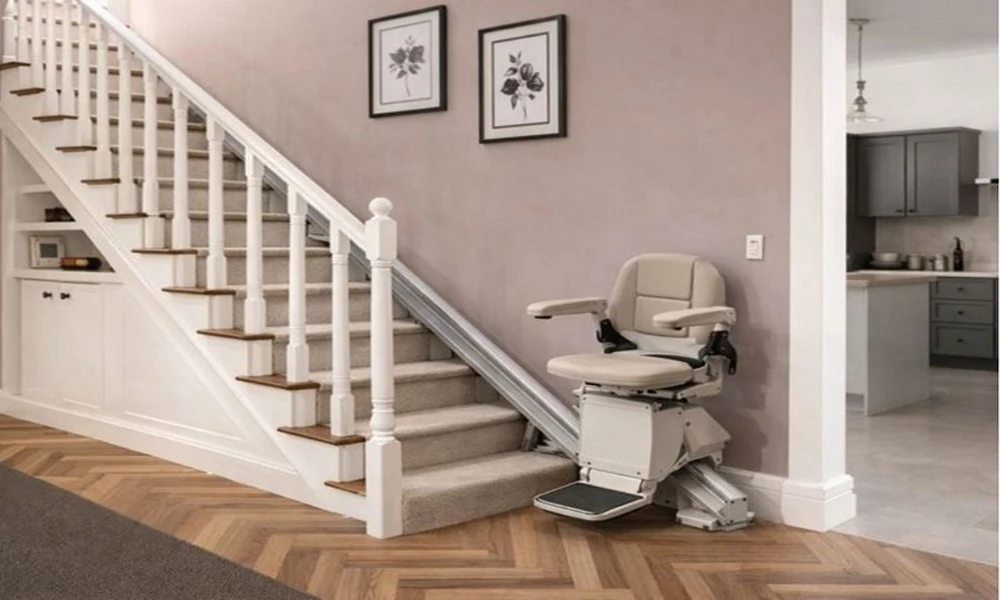
For a great many households the staircase is the single point at which a home stops working. Everything else remains manageable cooking, bathing, moving around a level but the stairs become an obstacle that gradually restricts someone to one floor of their own house. A stair lift running along the flight addresses that specific barrier directly, without the structural work or expense that a full elevator involves, and for the right situation it is a remarkably efficient solution.
How the Equipment Works
The system is simpler than most people expect. A rail is fixed to the treads of the staircase, not to the wall, so load is carried by the stair structure itself. A motorised carriage travels along that rail carrying a seat, footrest and armrests. The user sits, fastens a belt, and operates the unit with a joystick or rocker control on the armrest. Remote controls at the top and bottom allow the chair to be called or sent away when someone else needs the stairs. Battery power means the lift continues to operate during an outage and charges whenever it returns to a parking position.
Straight Versus Curved Installations
Staircase geometry drives both cost and lead time. A straight flight with no turns takes a standard rail, which can often be installed within a couple of hours of arriving on site and is significantly cheaper. Anything involving a turn, a landing, a curve or intermediate steps requires a rail manufactured specifically for that staircase, usually from a detailed survey or photographic measurement. Custom rails cost more and take weeks to produce, but they follow the stair precisely, carrying the user past a landing in one continuous journey.
Assessing Whether It Suits the User
The equipment assumes certain abilities, and being honest about them prevents an unsuitable purchase. The user must be able to transfer safely onto and off the seat, sit unsupported during travel, and operate the control. Where a wheelchair is used throughout the day, a seated lift means transferring twice per journey and having a second chair waiting at the top, which is workable for some households and impractical for others. In those cases a platform lift carrying the wheelchair itself, or a full residential elevator, is the better fit. An occupational therapist’s assessment is genuinely useful here, since needs often change over time.
Space and Stair Width
A common worry is that the lift will block the staircase for everyone else. In practice the rail projects only a modest distance and the seat, footrest and armrests fold flat against it when parked, leaving most of the stair width clear. Narrow staircases can still be tight, so measuring the remaining clear width at the narrowest point is worth doing before committing. Hinged rail sections are available where the bottom of the rail would otherwise obstruct a doorway at the foot of the stairs.
Safety Features to Confirm
Well-built units include several protections that should be checked rather than assumed. Obstruction sensors on the footrest and carriage stop travel if something is in the path. A seat belt restrains the user during movement. Swivel seats with a locking mechanism allow safe dismount at the top away from the stair edge. Constant-pressure controls stop the chair the moment the control is released. A soft start and stop avoids jolting. Battery backup ensures operation during a power cut. Overspeed governors prevent uncontrolled descent. Each of these is standard on reputable equipment and worth confirming line by line in a quotation.
Outdoor and Unusual Applications
Stairs outside the house create the same barrier and are sometimes overlooked. External units built with weather-resistant finishes, sealed components and protective covers handle entrance steps, garden levels and access from car porches. They need appropriate drainage at the base and a suitably protected electrical supply. Installations serving very short rises, or homes where the entrance steps are the only obstacle, may be better served by other equipment, so it is worth comparing before defaulting to a rail.
Installation and Disruption
Compared with almost any other accessibility work, this is a light-touch project. There is no structural alteration, no slab cutting and no shaft. A straight installation is typically completed in a single visit; a curved one takes longer to manufacture but installs in a day. The main requirement is a nearby power point. Because the rail attaches to the stair treads rather than the wall, the installation is generally reversible, with only small fixing points remaining if the unit is later removed which matters in rented or strata properties where consent may be conditional on reinstatement.
Cost and Long-Term Ownership
Straight units sit at the lower end of accessibility spending, while curved installations cost several times more due to bespoke rail manufacture. Reconditioned units are available and can represent good value, though warranty terms and parts availability should be checked carefully. Ongoing costs are limited to periodic servicing and eventual battery replacement, typically every few years. A service contract covering annual inspection and a defined response time is advisable, since a lift out of action immediately restores the barrier it was bought to remove.
Planning for What Comes Next
Needs rarely stay fixed. A household installing a stairlift today may face wheelchair use in five years, at which point the equipment no longer suffices. Where that trajectory is foreseeable, it is worth understanding what a full installation would involve a guide to specifying a home elevator in Singapore sets out the space and approval requirements. Discussing the longer view with an experienced supplier at the outset helps avoid spending twice on solutions that each only work for a few years.

