


Rain rarely gets into a house by soaking straight through a roof or a wall. It gets in at the seams: the eave where shingles end, the corner where a roof meets a sidewall, the gap behind a trim board, the joint where siding stops above the soil. Gravity pulls water down, wind pushes it sideways, and capillary action draws it upward into tight joints. Any spot where one material hands off to another is a likely entry point.
That is why an exterior works best as a single weather barrier rather than a set of separate parts. Each layer is meant to lap over the one below it, the way shingles overlap, so water keeps moving outward and downward. When one layer fails, the next one down takes a load it was never built to carry. An overflowing gutter soaks the fascia, the wet fascia feeds water behind the siding, and the siding passes it to the sill plate and foundation. In a freeze and thaw climate, trapped water expands every winter and widens every gap it finds.
Homeowners across Greater Chicago work with Strata Exteriors when they want the whole exterior evaluated as one system instead of patched one problem at a time. The team handles siding and shutter replacement, gutter and drainage design, and custom copper and specialty metal work such as ridges, valleys and hand-formed flashing. All of it ties back into a full exterior roofing scope that accounts for ventilation, flashing and the connection between roof and walls. If you are seeing stained siding, peeling trim or a damp basement corner you cannot explain, schedule an exterior evaluation and find out which layer is letting water through.
Following Water From the Roof Edge to the Soil
The roof edge. The last course of shingles should overhang the fascia, with a metal drip edge underneath that throws water into the gutter instead of letting it curl back onto wood. A missing or short drip edge is one of the most common reasons fascia boards rot from the top down. In snowy regions, an ice and water membrane along the eave adds protection when ice dams push meltwater back up under the shingles. For the walls below, how the edge is detailed matters far more than the shingle chosen above it.
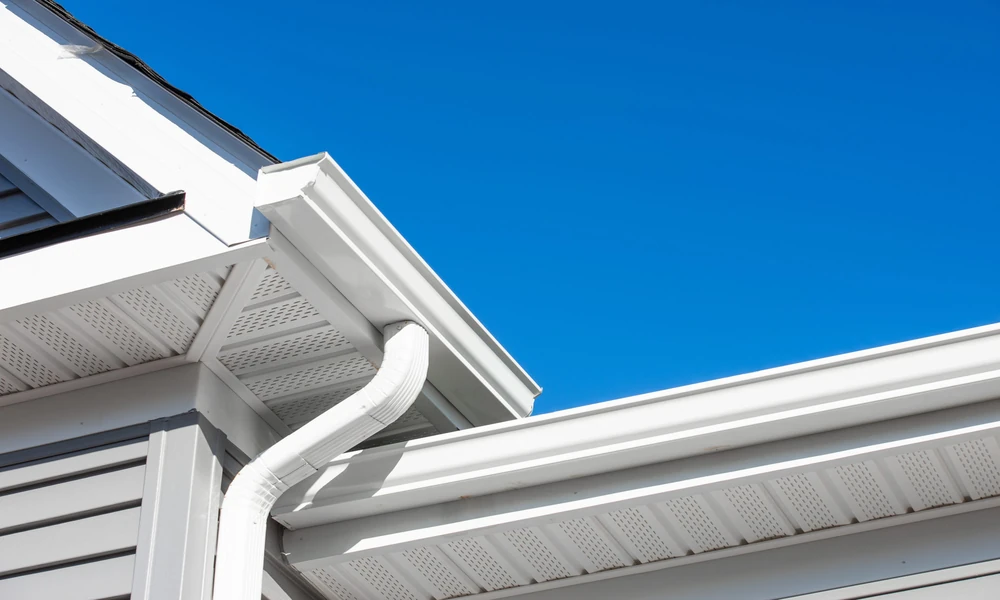
Gutters. A gutter has one job: collect roof runoff and carry it to a downspout without spilling. Overflow usually comes from three causes. The gutter is undersized for the roof area feeding it, the pitch is off (about a quarter inch of fall per 10 feet is a common target), or debris and ice block the outlet. Loose hangers let a full gutter sag, creating a low spot that holds standing water and pulls the back edge away from the fascia. Upsizing to 6 inch gutters with 3 by 4 inch downspouts is a common fix on large or steep roof planes that dump into a single run.
Downspouts and drainage. Moving water off the roof accomplishes little if it lands beside the foundation. According to the U.S. Department of Energy’s Building Science Education guidance on gutters and downspouts, just a few inches of rain on a house roof can produce several thousand gallons of runoff, and downspouts should discharge at least 5 feet from the foundation or feed an underground system at least 10 feet away. A short elbow and a splash block rarely meet that mark. Buried solid pipe that daylights downhill, or a properly sized dry well where the soil allows it, keeps the yard tidy and the basement dry.
Fascia, soffit and trim. Trim is where small leaks become structural repairs. Water from an overflowing gutter runs behind it, soaks the fascia and wicks into rafter tails. Soffit vents clogged with paint or insulation trap warm, humid attic air that condenses on the underside of the roof deck. The fix means replacing rotted wood with sound stock or a capped aluminum wrap, priming new wood on all six sides, and making sure the gutter’s back flange tucks behind the drip edge rather than sitting in front of it.
Kickout flashing. This small piece deserves its own label because it is missing so often. Where a lower roof runs into a sidewall and ends at a gutter, step flashing carries water down along the wall. Without a kickout at the bottom, that water pours straight behind the siding. Inspectors regularly find vertical rot streaks below these intersections, usually hidden until the wall is opened.
Siding. Siding is a rain screen, not a waterproof skin. Some water always gets behind it, so what matters is the water resistive barrier underneath and a clear path for that water to drain out at the bottom. Vinyl relies on loose laps and weep holes. Fiber cement needs flashing behind butt joints and a gap at trim instead of a thick caulk bead. Cedar and engineered wood last longer with a ventilated gap behind the boards so they can dry. Bubbling paint, swollen board ends and dark stains at window corners usually point to failed flashing, not just a tired finish.
Shutters. Decorative shutters are a frequent hidden leak. Every fastener that pins a shutter to the wall punctures the siding and the barrier behind it, and the narrow space behind a tightly mounted shutter collects leaves and holds moisture against the cladding. Mounting blocks, sealed fasteners and a small standoff gap let the wall shed water and dry out. Functional hinged shutters need hardware anchored into solid framing, not just sheathing.
Copper and specialty metal. Copper earns its cost at the spots that handle the most water: valleys, chimney and bay roof flashing, half round gutters, conductor heads and window caps. It can last for generations and weathers to a patina instead of rusting. The catch is chemistry. Runoff from copper corrodes aluminum and galvanized steel it touches, so a copper detail draining into aluminum gutters will eventually eat through them. Metals need to match or be properly isolated, and solder joints call for a craftsman who does this work regularly.
The ground line. The final layer is the one most often forgotten. Siding should stop about 6 inches above soil and roughly 2 inches above hard surfaces like patios and lower roofs, since splashback and drifting snow pile against the bottom courses. The ground itself should fall away from the house, and building codes commonly call for 6 inches of drop within the first 10 feet. Mulch beds built up year after year often bury the bottom row of siding and the sill plate, quietly turning landscaping into a moisture source.
Reading the Exterior as One System
When damage shows up on a wall, the cause usually sits one or two layers above it. Peeling paint on a lower siding course may trace back to a gutter outlet that clogged several seasons ago. A damp basement corner may start at a downspout that ends 18 inches from the wall. Repairing the visible damage without finding that source means paying for the same repair again. The exteriors that hold up longest are inspected from the top down, with every handoff between materials checked as carefully as the materials themselves.

