


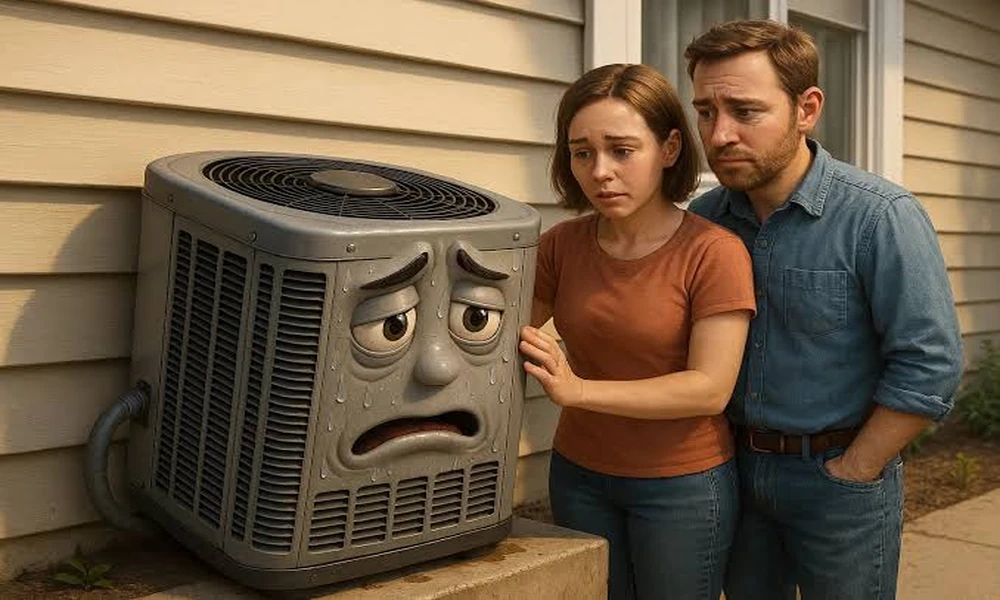
An air conditioner does two jobs at once. It lowers the air temperature, and it pulls water out of that air as it passes over a cold evaporator coil. HVAC engineers call these sensible and latent cooling. In dry climates the second job barely matters. In humid coastal regions it often decides whether a home feels comfortable at 76 degrees or sticky at 72.
Humidity problems tend to show up in fall. Outdoor highs drop, so the system satisfies the thermostat faster and runs shorter cycles. Dew points along the Gulf Coast, however, often stay high well into October, so the air still carries plenty of moisture. Short runs give the coil little time to get cold enough to condense that water and drain it away. Humidity creeps up while the thermostat reading looks perfectly normal.
Health and building guidance generally puts the healthy range for indoor relative humidity at 30 to 50 percent, and below 60 percent at the very least, because mold, dust mites, and mildew thrive above that. A cheap digital hygrometer from a hardware store gives you a real number instead of a guess. If readings sit above 60 percent for several days, one or more of the signs below is usually already visible somewhere in the house.
Homeowners across Lee, Charlotte, and Collier counties who notice these symptoms can turn to Avalanche Air Conditioning, a second generation Punta Gorda HVAC company whose owner has spent 16 years working on Southwest Florida systems. The team handles AC repairs and installation, routine maintenance, mini splits, duct work, duct cleaning, and indoor air quality upgrades, and it focuses on long term fixes over quick patches. A persistent humidity complaint is a good reason to book a diagnostic visit now, before the next cooling season puts the system under full load.
1. The House Feels Clammy at a Normal Setting
Your body cools itself by evaporating moisture from the skin. When the air is already saturated, that process slows, so 75 degrees at 65 percent humidity can feel warmer than 78 degrees at 45 percent. Most people respond by lowering the thermostat, which costs money without solving anything.
Before anything else, check the thermostat fan setting. With the fan on “ON” rather than “AUTO,” the blower keeps pushing air across a wet coil after the compressor stops, and much of the water that collected there evaporates right back into your rooms. Switching to AUTO is free and often makes a noticeable difference within a day or two.
2. Vents and Grilles Start Sweating
Beads of water on supply registers, or brown rings on the ceiling around them, mean cold air is meeting humid air at the vent. Sometimes indoor humidity alone is the cause. More often, the duct boot behind the grille is poorly sealed or uninsulated, and hot, damp attic air is leaking in around it.
Florida attics can climb well past 130 degrees in summer, so even small gaps matter. Sealing duct connections with mastic and properly insulating the boots usually stops the sweating. Ignoring it tends to end with stained drywall and, eventually, mold on the back side of the ceiling.
3. A Musty Smell Arrives With Each Cycle
An odor that appears in the first minute after the system kicks on usually comes from inside the equipment. A coil that stays wet and collects dust becomes a home for biofilm, and the drain pan below it can hold standing water for weeks.
A professional coil cleaning and pan treatment is the first step. Many homeowners now add UV lights aimed at the coil to keep growth from returning. Duct cleaning helps when there is visible debris or growth in the ductwork, but it only lasts if the moisture problem feeding that growth gets fixed too.
4. Short Cycles That End Before the Coil Drains
A system that runs for a few minutes, shuts off, and starts again shortly after is often oversized. Contractors who size equipment by square footage alone, rather than doing a proper Manual J load calculation, frequently install more tonnage than a home needs. The unit cools the air quickly but never runs long enough for steady condensate to form and drain.
This is where variable speed and inverter systems have changed the picture. Instead of running at full blast and stopping, they ramp down and run longer at low speed, which removes far more moisture per hour of operation. For anyone planning a replacement, right sizing matters more than raw capacity.
5. Water Shows Up Near the Air Handler
Algae and sludge build up inside condensate drain lines, especially in warm climates. Once the line clogs, water backs into the pan. If a float switch is installed, it shuts the system down to prevent overflow, and the house heats up and gets muggy fast. Without one, the water ends up on the floor or inside a wall.
Pouring a cup of white vinegar into the drain access every few months slows buildup, and a technician can clear stubborn clogs with suction. It is also worth confirming that a float switch exists at all, since older installations sometimes lack one.
6. Closets, Leather, and Wood Begin to Show It
Some signs build slowly. Spots of mildew on belts, shoes, or handbags in a closet, paperback pages curling, wooden doors that stick, or hardwood boards that start cupping all point to humidity that has stayed high for weeks.
Rooms kept closed, such as guest bedrooms and storage spaces, get less conditioned air and suffer first. A ductless mini split with a dry mode can handle a single problem room well. For stubborn whole house cases, a dedicated dehumidifier tied into the existing ductwork has become a common addition in humid regions.
7. Bills Climb While Comfort Drops
When the thermostat keeps moving lower to chase that sticky feeling, runtime and energy use climb with it. If the bill rises while the house still feels damp, the system is likely losing efficiency somewhere. A dirty evaporator coil, a clogged filter, restricted airflow, or an incorrect refrigerant charge can all reduce how well the coil removes moisture.
Older equipment adds to the problem. Systems built under earlier efficiency standards, especially single stage units nearing 15 years of age, simply do not manage humidity as well as current variable speed models. At that point, comparing a repair against a properly sized replacement is a fair calculation rather than an upsell.
Most of these signs connect to each other. A clammy room, a musty smell, and a sweating vent are often three faces of the same moisture issue, so tracking humidity with a hygrometer and noting when symptoms appear gives any technician a far clearer starting point.

